// On this page
- What Changed: Google's AI-Search Visibility Has Its Own Report
- The Measurement Boundary Matters More Than the Headline
- What It Means: AI Visibility Becomes a Real Operating Metric
- What To Do Next: Build a 30-Minute AI-Search Baseline
- What To Ignore: The New Reporting Does Not Validate AEO Shortcuts
- The Bottom Line
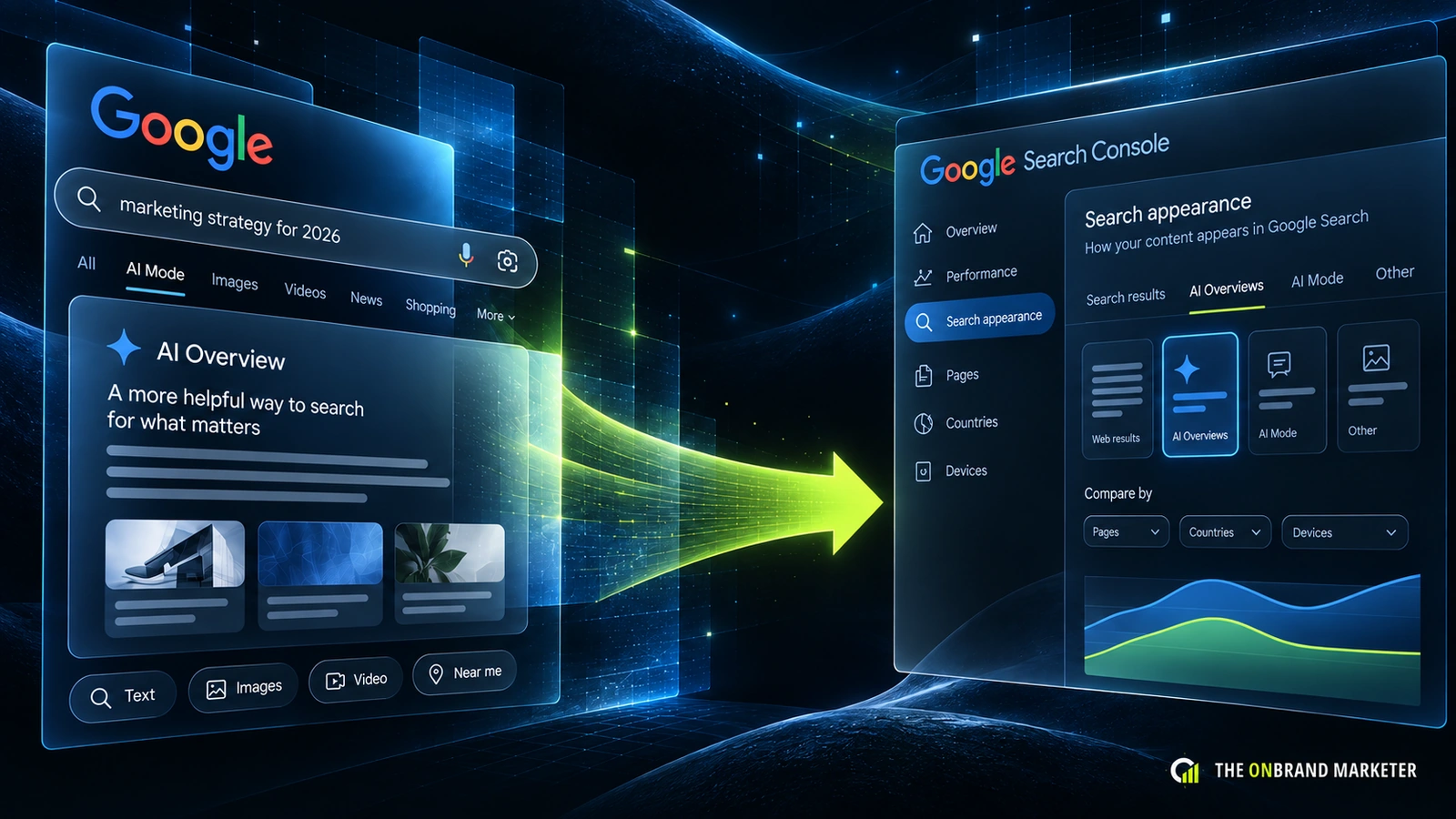
Google's dedicated Generative AI Search report measures impressions from AI Overviews and AI Mode, by page, country, date and device. It does not separately isolate AI-specific clicks, queries, CTR, conversions or incremental impact in that report.
This article interprets Google's official reporting documentation. The Onbrand Marketer has not analyzed a proprietary dataset or audited any reader's Search Console account.
What Changed: Google's AI-Search Visibility Has Its Own Report#
The most useful development in AI search this year might not be a new answer interface. It might be a clearer way to see what is happening to your own pages.
On June 3, 2026, Google introduced dedicated Generative AI performance reports in Search Console. The Search report shows impressions in features including AI Overviews and AI Mode. Google also introduced a separate generative-AI reporting view for Discover. On August 31, the company updated the Search Central announcement to say the new insights had rolled out to websites worldwide. Its current help documentation explains that a site may not see the Search report because it has not received enough qualifying impressions. Sources: Google Search Central announcement; Generative AI performance report (Search).
On September 24, Google announced an additional filter that separates text-based web search from multimodal web search—searches where an image is used as part of the query. Examples include Google Lens, Circle to Search, image uploads and Chrome image search. Google began rolling out that reporting globally on the announcement date. Source: Google Search Central's multimodal announcement.
These are meaningful improvements. But they do not turn Search Console into a complete AI attribution platform.
The Measurement Boundary Matters More Than the Headline#
The dedicated Search report answers a specific question: How often did Google show links to our pages inside supported generative-AI Search experiences?
For many teams, that question previously required inference from external visibility tools, sampling or overall search trends. Google's report now provides a platform-observed impression signal. That is valuable, provided the team names the metric accurately.
The source of the signal is Google's own platform reporting about your property. It is not first-party customer, sales, CRM or transaction data belonging to your business.
What the dedicated report includes—and what it does not isolate
| You can evaluate in the dedicated report | You cannot currently isolate there |
|---|---|
| Generative-AI Search impressions | AI-specific clicks or click-through rate |
| Pages receiving those impressions | The exact search queries driving each AI impression |
| Countries where impressions originate | Whether a given impression came from AI Overviews versus AI Mode |
| Devices and date trends | AI-specific average position in this dedicated view |
| Text-based versus multimodal search type, where the filter is available | Which particular image, source sentence or selection decision produced the appearance |
| Exportable impression data | Downstream leads, pipeline, revenue or incrementality |
Important qualification: This is the limitation of the dedicated generative-AI impression report. It does not mean that clicks in AI Overviews or AI Mode are invisible to Search Console as a whole. Google's broader Search performance methodology explains how external-link clicks, impressions and positions are counted in those experiences. Those observations are not exposed as a dedicated AI-only clicks-and-conversions view in the generative-AI report. Sources: Google report help; Google's click and impression definitions.
There is another practical caveat. Google's chart is aggregated by property, while a page-grouped table is aggregated by page; totals can differ for legitimate methodological reasons. Google's documentation also notes the familiar 1,000-row table limit and the possibility of preliminary recent data. Treat an apparent total mismatch as something to reconcile, not immediate proof of missing traffic. Source: Google Search Console Help.
What It Means: AI Visibility Becomes a Real Operating Metric#
For a VP of Marketing, the right question is no longer just “Are we showing up in AI search?” It is “Which business-relevant pages are appearing, in which markets, and what changed after we made an investment?”
A total impression line is a useful opening diagnostic. On its own, it is a weak executive KPI. If a new batch of educational articles generates AI impressions in countries your company does not serve, that means something different from product-comparison or service pages appearing in your priority market.
This is where marketing judgment enters the reporting model. Google supplies exposure data. Your team must supply a meaningful content taxonomy, business priorities and downstream outcome data.
A better executive measurement ladder
Visibility → visits → recognized leads/orders → pipeline/revenue → incremental impact
The stages answer different questions:
- —Visibility: Did our pages appear in the specified Google AI features? Use the dedicated generative-AI report.
- —Visits: Did a person arrive on our site? Use web analytics and correctly labeled acquisition reports, understanding that Search Console's dedicated AI report does not isolate those clicks.
- —Business outcomes: Did the visit contribute to a known lead, order, opportunity or customer outcome? Reconcile against your commerce and CRM records.
- —Incrementality: Would that business outcome have happened without the specific marketing investment? That requires a defensible causal design—not simply another attribution setting.
Do not combine these into a single unqualified “AI search ROI” number.
What To Do Next: Build a 30-Minute AI-Search Baseline#
This is an operating review, not a new reporting bureaucracy. Run it monthly at first; increase frequency only if the metric supports real decisions.
Minutes 0–5: Establish the property-level trend
Open the Generative AI Search report for each important Search Console property. Record the reporting window, total AI-search impressions and whether the latest data is preliminary. Use an initial period long enough to avoid overreacting to one volatile day.
Do not treat a missing report as zero AI visibility without checking Google's eligibility and reporting explanation.
Minutes 5–12: Group the pages by business purpose
Export page-level data and classify URLs into a handful of cohorts:
- —Product, service and solution pages.
- —Comparisons and buying guidance.
- —Educational/editorial content and original research.
- —Technical documentation, support and help resources.
- —Visual or image-rich product pages.
A page-cohort view is more actionable than a list of twenty URLs. It can tell you whether Google is surfacing only top-of-funnel education or also the assets closest to a buying decision. It cannot establish why Google's systems selected those pages.
Minutes 12–18: Check market and device fit
Segment by country and device. A change concentrated in an irrelevant geography should not get the same executive treatment as a change in a core market. Likewise, a mobile-heavy result can suggest an area to examine, but it does not prove that mobile caused the change.
Minutes 18–23: Establish a separate multimodal view
Where the new search-type filter is available, record text-based and multimodal impressions separately. This matters especially for image-rich categories: retail, property, home products, travel, design, food, technical equipment and visual how-to content.
Do not create an artificial historical multimodal trend if the reporting period or backfill behavior has not been documented. The report tells you about search involving images; it does not identify a specific picture as the cause of an impression. Source: Google's September 24 announcement.
Minutes 23–27: Add operational annotations
Record material changes that could matter: major content updates, new original research, internal-link improvements, page migrations, significant crawl/indexing fixes or product launches.
An annotation creates context for investigation; it does not demonstrate causality. And before assigning a sharp movement to a site change, check for platform issues. Google documented a logging error affecting generative-AI Search impressions for August 13–17, 2026, and says the missing data was restored on August 21. Source: Search Console data anomalies.
Minutes 27–30: Make one decision
Choose exactly one:
- 01Investigate: a strategically important page cohort is missing or declining.
- 02Improve: a high-value cohort appears consistently but the underlying page is outdated or weak.
- 03Instrument: analytics or CRM reporting cannot connect visits to business outcomes.
- 04Observe: there is no defensible reason to change anything yet.
The aim is a better decision, not a more elaborate dashboard.
What To Ignore: The New Reporting Does Not Validate AEO Shortcuts#
More measurement does not mean Google has introduced a separate set of optimization rules for AI answers.
Google's official optimization guidance says its generative Search features continue to rely on core search ranking and quality systems. The company emphasizes indexable and crawlable pages, useful non-commodity content, clear structure, and appropriate images and video. It explicitly rejects the need for special AI schema, tiny content “chunks” or llms.txt as a Google Search visibility mechanism.
That guidance applies to Google Search. It does not establish how every external answer engine treats every file or markup convention.
The practical response is to make normal SEO more accountable: publish useful original material, fix genuine technical access issues, keep key pages clear, and inspect actual performance. Do not buy a speculative “AI citation guarantee” because an impression graph has appeared in Search Console.
The Bottom Line#
Google now provides platform-reported impression data about a site's appearances in its generative-AI Search features. This is a Google-observed visibility baseline—not the site's own customer-outcome data. The September multimodal filter adds another useful lens.
That baseline is worth building. It can identify which page groups are participating in Google AI Search, where impressions originate and whether visibility changes over time.
But AI visibility is not AI traffic. AI traffic is not conversion. Conversion attribution is not incremental impact.
Use Search Console for the first part of the question, your business systems for what happens next, and causal methods when the decision requires proof that an investment made a difference.