// On this page
- What Changed: Paid Discovery May Now Have a Conversation Layer
- Keep the Product Statuses Separate
- What It Means: The Answer Becomes Part of the Creative
- Measurement: A Platform Dashboard Is Not the Same as Business Impact
- What To Do Next: Prepare a Sponsored Conversation Readiness Review
- What To Ignore
- The Bottom Line
Sponsored Agents are a limited-alpha ChatGPT advertising format. A user can choose a separate, labeled conversation with an advertiser's AI representative from an ad and follow a link to the business's website. Universal native CRM capture, checkout and general advertiser access are not established.
This analysis describes publicly documented capabilities and editorial implications as of October 12, 2026. The Onbrand Marketer did not test a live Sponsored Agent campaign, and does not claim access to OpenAI's limited alpha.
What Changed: Paid Discovery May Now Have a Conversation Layer#
The pivotal change in ChatGPT advertising is not simply that advertisers can buy placements in the product. It is that OpenAI is testing a format in which the interested user can talk to an AI representative of the advertiser before proceeding to the business's own site.
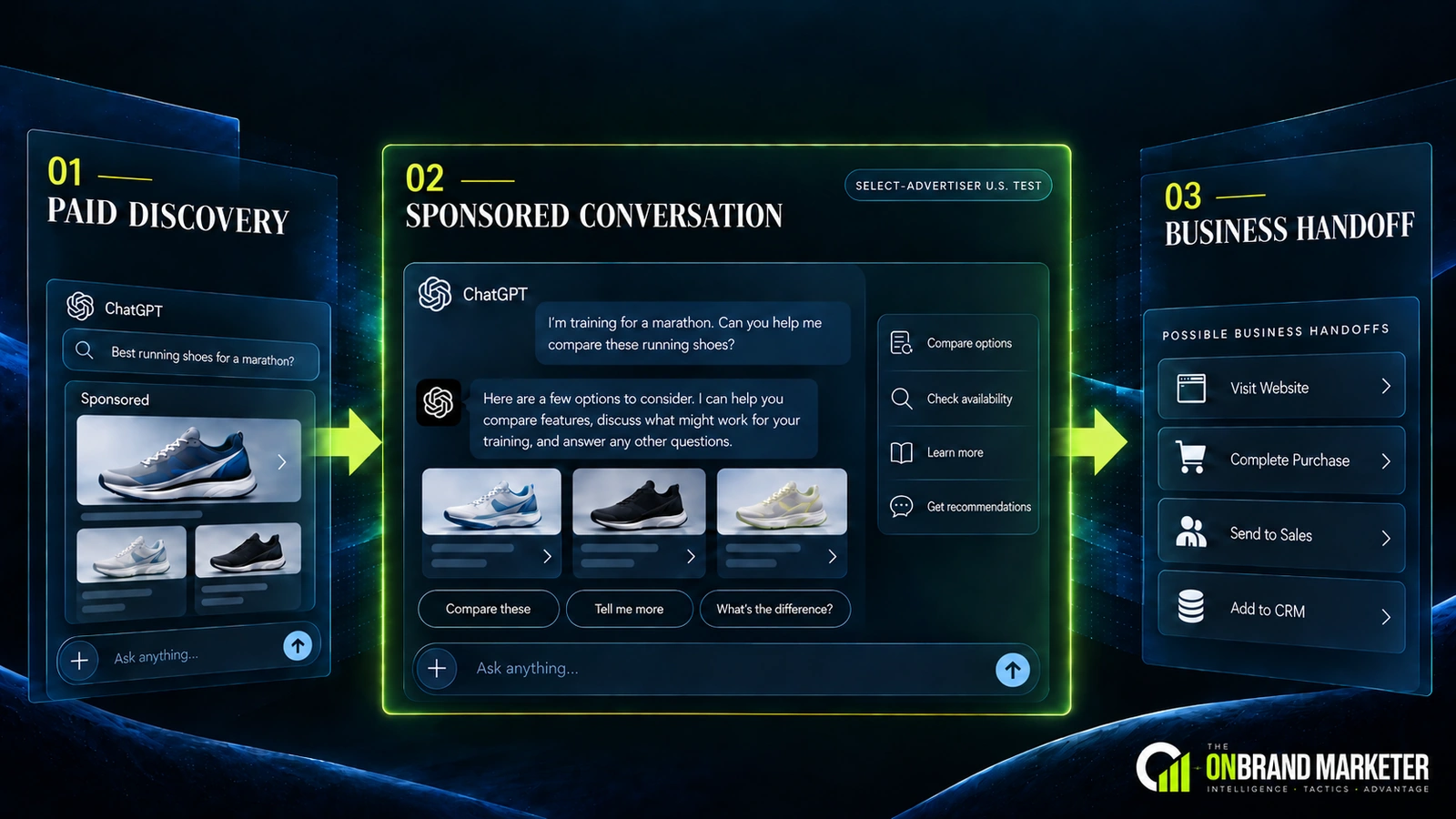
On September 16, 2026, OpenAI introduced Sponsored Agents. According to its announcement, a user who sees a relevant ad can choose a clearly labeled conversation with a business-sponsored agent, ask follow-up questions about a product or service, and follow a link to the advertiser's website. OpenAI says the sponsored conversation is separate from ChatGPT's independent answers and separate from the user's original chat. The company said the format was being tested with select U.S. advertisers. Source: OpenAI's September 16 announcement.
That is the product fact. The operating model below is The Onbrand Marketer's interpretation, not OpenAI's official funnel terminology:
Paid discovery → optional sponsored conversation → product/fit clarification → website handoff → downstream business outcome.
The important word is optional. A Sponsored Agent is not a universal replacement for a landing page, product site, CRM, sales team or checkout. Its general public documentation establishes an ad-to-conversation experience and a link to the advertiser's site—not a full customer data or revenue system.
Keep the Product Statuses Separate#
Marketing leaders should resist the temptation to call everything in OpenAI's advertising announcements “live.” Distinct products have distinct access rules.
| Capability | Documented status as of October 12, 2026 | What that means for a marketing team |
|---|---|---|
| ChatGPT Ads / Ads Manager | Beta, expanding via eligible self-serve access in supported markets. | A qualifying advertiser can explore campaigns, reporting and conversion measurement; not every market or account has all access. |
| Sponsored Agents | Limited alpha, selected advertisers; the Help Center says early-access requests are not currently being accepted. | Plan readiness now; do not budget on the assumption that your team can deploy this format immediately. |
| AI creative and campaign management tools | September 16 rollout included natural-language campaign controls through an Ads Manager plugin and AI creative assistance. | Assess these as advertiser workflow tools, not as proof the conversational format is generally available. |
| HubSpot / Shopify integrations | ChatGPT Ads partner integrations with separate eligibility. OpenAI currently documents HubSpot where ChatGPT Ads is available; its Shopify Help describes U.S. availability with wider expansion ahead. | Integration with ChatGPT Ads is not proof that every Sponsored Agent creates a CRM record or completes an order. |
| Visual ads during ChatGPT image generation | Announced October 5 for a planned U.S. test later in October, initially among eligible Free/Go users and selected advertisers. | A separate announced ad format, not an available Sponsored Agent capability or a launch already proven by October 12. |
Sources: OpenAI Sponsored Agents Help; Ads Manager FAQ; September 16 product announcement; HubSpot Help; Shopify Help; October 5 announcement.
The Shopify timing discrepancy is a useful warning
OpenAI's September 16 announcement anticipated international availability of the Shopify app in supported ads markets starting September 23. Its more recent Shopify Help Center wording, however, describes U.S. availability and says broader access is coming. For an operational go/no-go decision, check the current product documentation and actual account eligibility rather than treating a launch-plan date as a guarantee. Source: OpenAI Shopify Help.
What It Means: The Answer Becomes Part of the Creative#
In a conventional campaign, the ad's job is frequently to earn a qualified click; the landing page handles detail, comparisons and objections.
A sponsored conversation moves some of that detail into the paid experience itself. A customer may ask whether a chair fits a small space, whether a service covers a particular market, or how two product configurations differ. The advertiser's representative may be expected to answer before the user ever reaches a company-owned page.
That creates three operating consequences.
1. Product truth is now media infrastructure
A static ad can misstate a promotional detail. A conversational representative can repeat that misstatement across an open-ended exchange, potentially in a more persuasive voice.
OpenAI's Ad Tools Terms are a useful signal of the inputs that matter. They encompass product data, inventory and availability, pricing and promotions, website content, instructions, business logic, sales/support scripts and brand guidance. The terms assign advertisers responsibility for their materials and for a Sponsored Agent's content, configuration, Actions and Output where such an agent is made available.
A marketing team should therefore know which system or person owns each answerable claim: pricing, inventory, eligibility, comparison, product fit, policy exception and promotion expiration. A product truth register does not need to be sophisticated software to be useful; it does need named authority and timely revision.
2. The customer handoff needs its own design
OpenAI's general Sponsored Agent description confirms that the person can follow a link to the business's website. It does not establish a universal native lead object, calendar booking, CRM enrollment, persistent prospect identity or checkout inside every Sponsored Agent.
That matters because the same September product announcement also discussed HubSpot and Shopify. Those are meaningful ChatGPT Ads platform integrations. They should not be silently relabeled as individual Sponsored Agent features.
Decide, before a pilot, what constitutes success for your business: a qualified visit, a consented lead, a verified order, a completed application or a human sales conversation. Then design what happens at the website boundary and who owns follow-up.
3. More conversational detail means more claims risk
A chatbot acting inside a paid customer journey may face questions about guarantees, regulated requirements, direct competitor comparisons, exclusions and unavailable offers. Some of those questions should not be answered from an unreviewed marketing script.
Define the boundary between approved answer, uncertain answer requiring qualification, and human escalation. Test expired offers, ambiguous questions, multiple products with similar names and situations where “I don't know” is the responsible response.
This is not a claim that OpenAI currently exposes a configurable enterprise-grade governance console for every advertiser. It is a recommendation for how marketers should prepare their own source material and acceptance tests.
Measurement: A Platform Dashboard Is Not the Same as Business Impact#
ChatGPT Ads has an increasingly substantial reporting stack. OpenAI's current documentation lists impressions, clicks, spend, CTR, average CPC, average CPM and attributed conversions when measurement is configured. Supported conversion measurement involves the OpenAI Pixel and/or Conversions API, available click references such as oppref, deduplication identifiers, and selected attribution windows. Current documentation also addresses eligible view-through reporting. Sources: OpenAI Measure Results; Conversion Measurement.
The important interpretation is not that platform reporting is invalid. It is that different parts of the funnel require different data authorities.
| Question | Start with |
|---|---|
| How much paid exposure, spend and attributed campaign activity did the platform record? | Ads Manager, with attribution settings and reporting dates recorded. |
| Did a prospect arrive on the advertiser's site? | Site analytics and tagged destination measurement, reconciled with click reports. |
| Did a valid lead, sale or opportunity exist? | CRM, commerce and internal systems, with appropriate consent/data quality. |
| Did the ad generate outcomes that would not otherwise have occurred? | Controlled experimentation or other credible causal methods, not attributed conversion totals alone. |
OpenAI itself documents reasons its attribution totals can differ from external analytics, including different windows and models, event timing, browser/consent limitations, and deduplication. Source: OpenAI Conversion Measurement.
The October 5, 2026 announcement adds useful nuance. OpenAI named additional conversion, attribution and measurement partners and described early-stage work with incrementality partners on geo-based experiments. It also highlighted selected company/partner-reported results. These examples should not be treated as independent, representative benchmarks for the ad platform—or as performance proof for Sponsored Agents specifically. The platform's own FAQ still says it lacks benchmarks across advertisers, industries and campaign types. Sources: OpenAI October 5; Ads FAQ.
Attribution is not incrementality. A conversion can be attributed to an ad under a stated rule without proving that the ad caused an additional conversion.
What To Do Next: Prepare a Sponsored Conversation Readiness Review#
Most marketers do not need Sponsored Agent access to start doing the useful work. Run this cross-functional review before committing launch resources.
Establish five operating contracts
- 01Product data contract. List the canonical owners and refresh/expiry rules for pricing, stock, features, policies, service areas and live promotions.
- 02Claims contract. Maintain approved statements, substantiation, comparative claims, prohibited promises, jurisdiction-sensitive language and escalation thresholds.
- 03Conversation contract. Define the questions a sponsored representative should answer, qualify, refuse to infer or route to a human.
- 04Handoff contract. Decide whether the documented website handoff should lead to a product page, consultation, quote, lead form or purchase journey. Specify the first consent point for CRM follow-up.
- 05Measurement contract. Assign ownership of platform events, site visits, lead/order records and any incrementality test; document identity limits and data reconciliation.
Give one person cross-functional accountability
Paid media may own bidding and campaign economics. Product marketing should own offer accuracy. Marketing Ops and analytics should own event definitions and integrations. CRM/lifecycle should own consented follow-up. Legal or compliance should review claims where necessary. Someone must coordinate those workstreams rather than assuming the buyer of media inventory owns every consequence of the conversation.
Run failure-case testing
Ask what happens when:
- —a promotion expired yesterday;
- —a user asks for a guarantee not supported by the offer;
- —two similar products have different availability;
- —a policy exception needs human approval;
- —a person wants a callback without consenting to marketing enrollment;
- —tracking parameters are lost after a redirect;
- —attributed leads do not match CRM records.
These tests establish readiness. They do not prove performance; that requires a permitted pilot, sound instrumentation and real outcomes.
What To Ignore#
Do not assume Sponsored Agents are generally available, can be requested on demand, outperform landing pages, create CRM contacts natively, close every checkout or carry user identity across systems. Do not assume partner integration equates to Sponsored Agent capability. Do not treat a paid platform's attributed conversions as incremental lift. Do not equate a planned image-generation ads test with a launched product.
Nor should marketers assume the rise of conversational advertising eliminates their website. The best-supported current Sponsored Agent journey still leads people to the advertiser's site for the next step.
The Bottom Line#
Sponsored Agents suggest a more consequential form of paid media: the branded response itself becomes part of the marketing experience.
For senior operators, the question expands from “What creative should we run?” to “What is the business allowed to say, what systems make those statements true, and who owns what happens next?”
The format is early. The readiness work is not. Product truth, claims discipline, handoff ownership and independent measurement will matter whether the next interface is an ad card, a conversation, a product feed or another AI-native commerce experience.